In brief
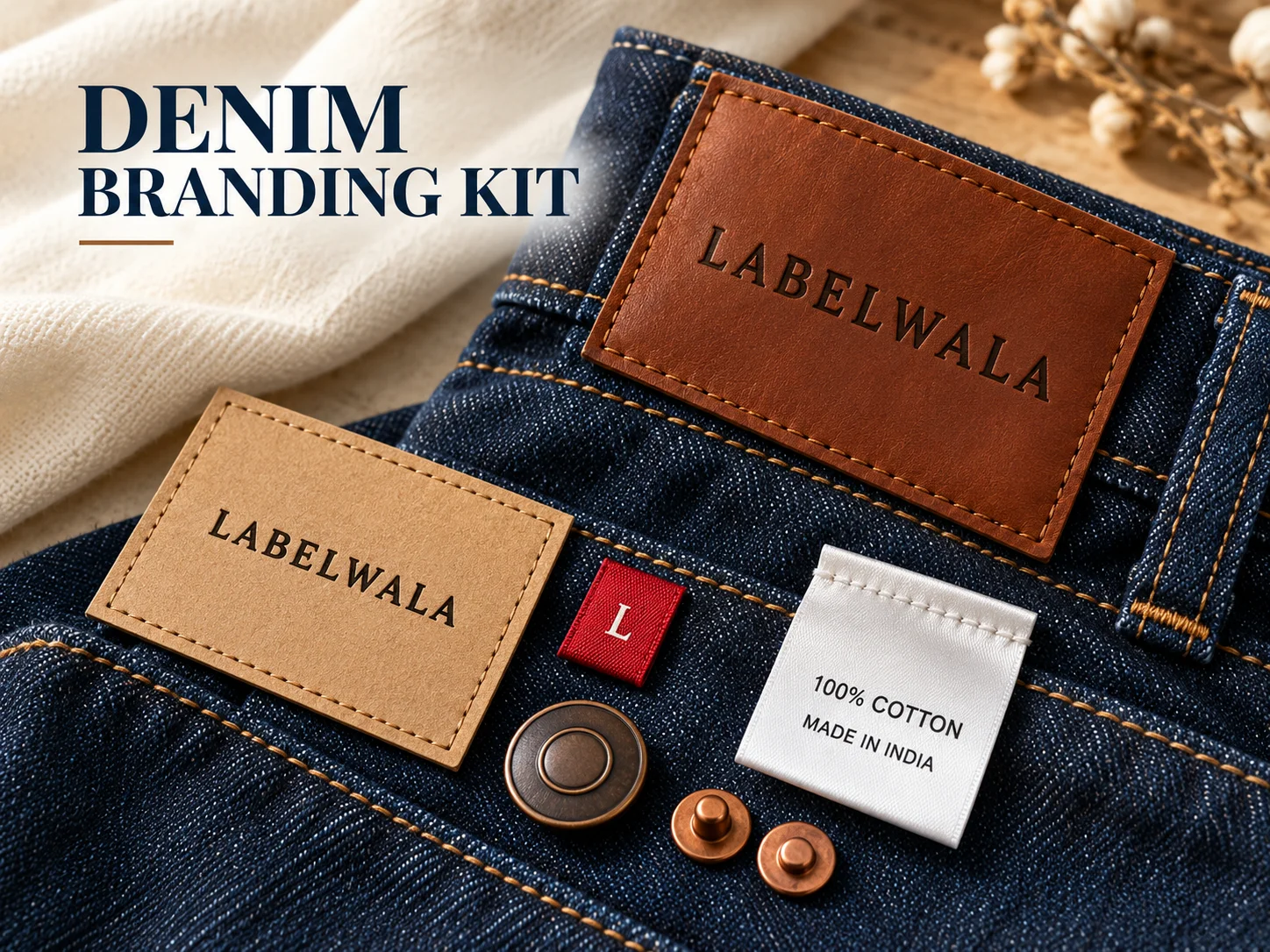
A denim brand needs a back-waistband patch in leather, faux leather or jacron with a debossed logo, a woven brand and size label inside the waistband, a care label in the pocket bag, and branded rivets and a shank button. Every piece must survive the garment wash, so tell your supplier your wash recipe: stone, enzyme, bleach or ozone.
Denim is unlike almost any other garment to brand. It's washed hard, worn constantly, and expected to last for years and look better as it ages. That means every label on a pair of jeans, from the waistband patch to the inside label to the rivets, has to be genuinely durable and wash-resistant, or it lets the whole premium product down.
Here's the full denim branding kit, the leather-vs-jacron decision, and how to make sure it all survives the wash.
What is in the denim branding kit?
- Leather, faux leather or jacron
- Debossed logo, back-right waistband
- The signature denim element
- Woven or printed brand + size
- Wash-resistant care label
- Rivets & a branded shank button
Leather or jacron: which waistband patch?
The back-waistband patch is the signature denim branding element. You have three options:
Most premium, ages to a patina. Costs more and can stiffen with heavy washing, best for premium ranges.
The leather look, lower cost, vegan, more consistent through washing.
The classic jeans patch: vegan, cost-effective, consistent, wash-friendly. The denim industry standard.
All three take a debossed logo, the recessed impression that reads classic and wears beautifully.
Many denim brands pick jacron or faux leather for durability and vegan appeal, reserving genuine leather for premium lines.
Why must every denim label survive the wash?
Denim is washed hard. Every label (patch, inside label, care label), must be durable and wash-resistant. Labels that fray, fade or peel look cheap fast on a premium product. Always test-wash a sample through your actual wash process before committing to bulk.
There is a specific reason denim is harder on labels than any other category, and it is not the customer's washing machine. It is garment washing: the industrial process the finished jeans go through at the factory, after they are sewn, to produce the colour and hand you actually sell.
In almost every other garment, labels only ever meet a domestic wash. In denim, the labels are stitched in first and then put through the harshest treatment the garment will ever see:
- Stone wash, pumice tumbling with the garment for hours. Purely abrasive, and brutal on patch edges and printed surfaces.
- Enzyme wash, cellulase enzymes eating away at the cotton surface. They do not distinguish between your denim and a cotton label.
- Bleach and hypochlorite for lighter shades, which strips colour from anything that is not bleach-stable.
- Ozone and laser finishing, increasingly common as water-saving processes, with their own effects on printed surfaces.
- High-temperature tumble drying afterwards, often hotter and longer than domestic drying.
So the question to put to your supplier is not "will this survive washing?" but "will this survive my wash recipe?" A label that is perfect for a shirt can be destroyed in a single stone-wash cycle before the jeans have ever left the factory.
Tell your label supplier which wash process your jeans go through, stone, enzyme, bleach, ozone, at quote stage. It changes the patch material, the ink, and whether the patch is attached before or after washing.
Before the wash or after it?
This is the decision that quietly determines your whole specification, and plenty of brands never realise they made it.
Attached before washing is the traditional route and the reason denim looks the way it does. The patch and labels age with the garment: the patch picks up the same abrasion and fading as the fabric around it, so the finished jeans read as one object rather than a garment with branding stuck on afterwards. That authenticity is the whole appeal, but everything has to survive the process, which rules out most ordinary materials.
Attached after washing protects the branding completely. The patch stays crisp, colours stay true, and you can use materials that would never survive a stone wash. The cost is that the patch looks new against aged denim, which on a heavily distressed jean reads as an afterthought. It also adds a sewing operation after finishing, which factories dislike.
Most volume denim attaches the patch before washing and specifies jacron, precisely because jacron takes the process well. Premium and raw denim, where there is little or no wash to survive, has more freedom.
Where labels go on jeans
Back-right of the waistband, the hero.
Brand + size at centre-back or side waistband.
Side seam or pocket bag.
Branded rivets and a shank button.
Branded rivets & buttons
Custom rivets and a branded shank button carry your logo on the metal hardware, reinforcing a premium look alongside the waistband patch. They're usually sourced alongside your labels and patches so the branding stays consistent across the whole garment: from patch to inside label to hardware.
What size and placement should the patch have?
The waistband patch is the most visible thing you will specify, and it is easy to get subtly wrong in ways that look amateur next to established brands.
- Typical finished size runs around 50-70 mm wide by 40-55 mm tall. Larger reads as workwear or streetwear; smaller reads as premium and restrained.
- Position is the back-right of the waistband, just past the centre-back seam, sitting above the right back pocket.
- Keep it clear of the belt loop. A patch crowding or overlapping a loop is the single most common placement error, and it is very visible.
- Align the top edge with the waistband seam, or set a consistent gap below it, and hold that gap across every size in the range.
Size the patch against your smallest waist as well as your largest. A patch proportioned for a 38 can crowd the loop and the pocket on a 28, because the waistband got shorter and the patch did not.
How does the logo go onto the patch?
Three methods, with very different survival rates through a garment wash.
- Debossing presses the logo into the material as a recess. Because it is a physical deformation rather than a coating, there is nothing to wear off. It survives stone and enzyme washing and looks better as the surrounding surface ages. It is the default for good reason.
- Printing gives you colour and fine detail that debossing cannot, but it sits on the surface, so it abrades in a stone wash. Viable on lightly washed or raw denim, risky otherwise.
- Foil or metallic looks striking on a sample and rarely survives an aggressive wash intact. Treat it as a premium, low-wash option.
Debossing has one design constraint worth knowing early: it reproduces shape, not colour, so a logo that depends on two colours to be legible will not read. Fine lines also fill in. If your mark is detailed, simplify it for the patch instead of hoping the deboss holds, the same discipline heritage brands apply to their woven labels.
Which inside labels does denim need?
Behind the patch, the internal set has denim-specific requirements:
- Brand and size label at centre-back or inside the waistband. Woven, because it has to take the same wash and then years of belt abrasion.
- Size marking in waist and length, since denim sizes are usually two numbers. That needs a wider tab than a letter size, around 20 × 35 mm.
- Care label in the pocket bag, which is the most protected position on a pair of jeans and the reason the care information survives when the neck of a shirt would not.
- Composition, which on stretch denim means naming the elastane, and that in turn changes the care symbols, since elastane rules out hot tumble drying.
Put "wash separately" and "wash inside out" on the care label in text. Indigo is a surface dye that crocks onto everything for the first several washes, and the first-wash complaint that a new pair of jeans ruined a white shirt is entirely preventable with one line of type. See our care symbol guide for the full set.
Raw and selvedge denim is a different brief
If you sell raw or one-wash selvedge, most of the durability problem disappears, because there is no aggressive garment wash to survive. What replaces it is a much higher bar on materials and honesty.
Raw denim buyers are unusually informed and read the details closely. Genuine leather makes sense here in a way it rarely does on washed denim, because the patch will age slowly with wear rather than being battered in a machine. The selvedge ID, the fabric mill, the weight in ounces, these are things this customer wants stated, and the labels are where they are stated.
The trade-off is that a leather patch and raw indigo both need a warning: the patch can mark light-coloured surfaces and the denim will crock heavily. That belongs on the hangtag rather than buried on a care label.
Test it through your real wash
The only test that means anything in denim is the one that uses your actual recipe, on your actual fabric, with the labels attached the way they will be attached.
- Stitch the patch and labels to a scrap panel or a sample pair, exactly as production will.
- Send it through the full wash cycle at your laundry, not a domestic machine.
- Check the patch edges first, corners lift before faces fail.
- Check whether the deboss is still legible after abrasion, and whether any print has worn through.
- Check that the inside labels are still readable and have not gone brittle.
- Then wash it domestically a few more times, for what happens after the customer buys it.
Do this before the bulk order, on every wash recipe in your range. A patch that survives an enzyme wash may not survive the bleach wash you use for the light shade, and those are the same jeans in two colourways.
Getting denim labels made at Labelwala
We make woven and printed labels in Ahmedabad, Gujarat, and we have been doing it for 25 years. Denim enquiries usually cover the whole kit at once, because the patch, the inside labels and the care label all have to clear the same wash.
- Minimum order: 1,000 pieces per design. Quoting the set together is one job rather than several.
- Quotes: usually within 2 hours on a working day.
- Production: 7-10 days once artwork is approved. Rush jobs run 3-5 days.
- Care symbols: set to ISO 3758.
- Delivery: across India, depending on destination and consignment size.
Tell us your wash recipe and whether the patch goes on before or after washing. Those two answers determine the material and the method, and they are worth more at quote stage than a target price is.
We are rated 5.0 on Google from 27 reviews. Ask for samples you can put through your own laundry before committing to a run.
Common mistakes
- Specifying a patch without telling the supplier which wash recipe it has to survive.
- Approving a patch sample that has never been through a garment wash.
- Choosing genuine leather for a heavily stone-washed range because it photographs well.
- A detailed, two-colour logo debossed into a patch, where it reads as a blur.
- A patch sized for the largest waist that crowds the belt loop on the smallest.
- Putting the care label in a side seam rather than the pocket bag, where it would have been protected.
- Forgetting the elastane in stretch denim, so the care symbols permit a hot tumble dry.
- No "wash separately" line, and a first-wash complaint about indigo on a white shirt.
Denim punishes specification errors harder than other categories because the damage happens at the factory, before anyone has inspected the finished garment. By the time a patch has failed in the wash, you are looking at a whole batch rather than a returned unit.
The short answer
A denim brand needs a back-waistband patch (leather, faux leather or jacron with a debossed logo), a wash-resistant inside label with brand and size, a durable care label, and often branded rivets and a shank button. Because denim is washed hard and worn for years, every element must be durable: jacron and faux leather handle washing more consistently than genuine leather, which suits premium ranges. Always test-wash a sample first. Send us your logo and the elements you need for a combined quote and samples built for denim.