When activewear, innerwear and yoga brands ask "what's the best label for our garment," the conversation almost always splits in two: heat-press transfer (no fabric label. The brand info is printed directly onto the inside of the garment via heat and silicone or ink), or woven label (the traditional jacquard-woven fabric strip stitched into the neckline). They're built for completely different jobs but compete for the same buyer.
This guide compares them head-to-head: feel, durability, design flexibility, MOQ economics, and which garments belong on which method. By the end you'll know whether your brand should go tagless or stay traditional.
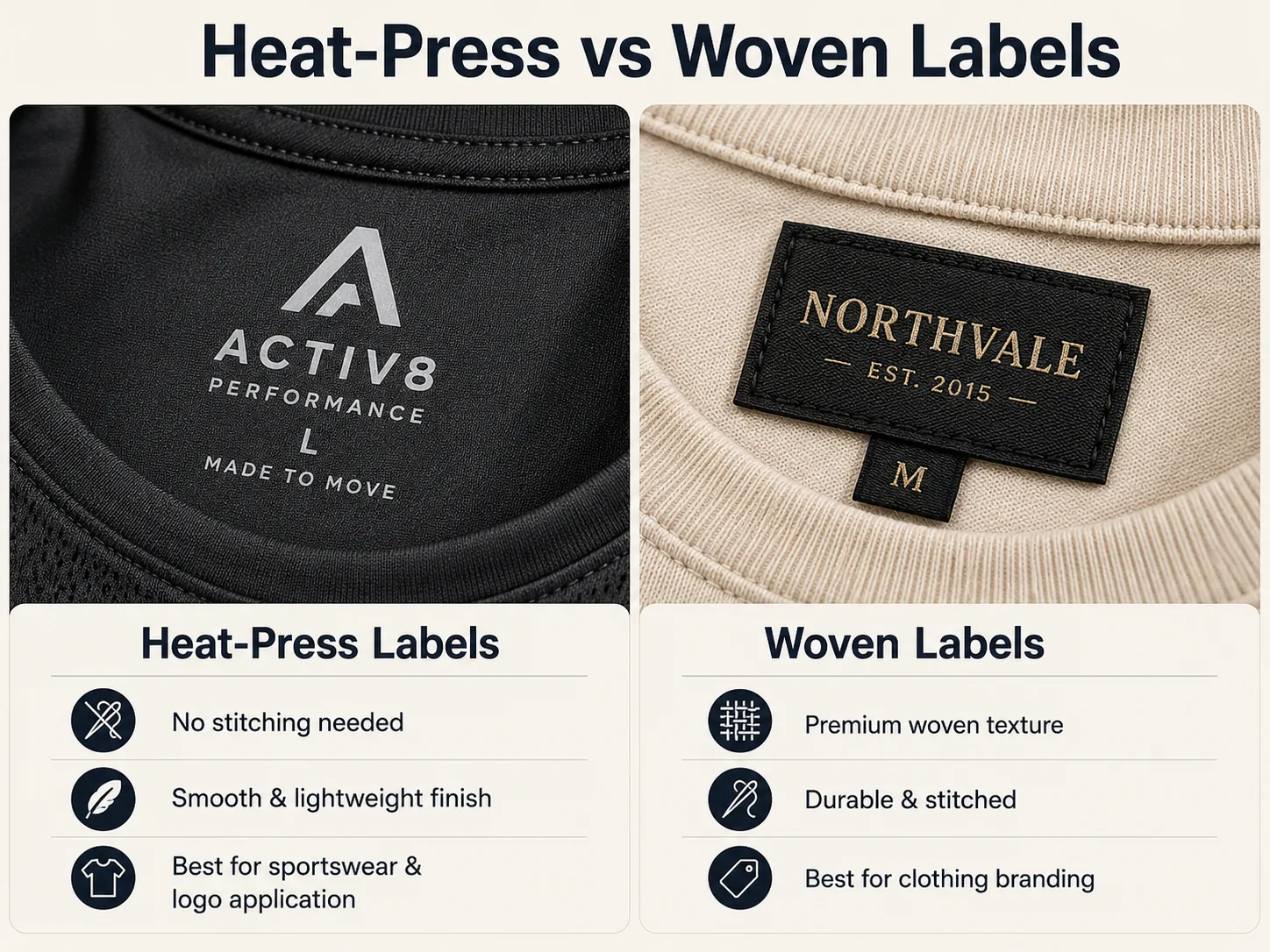
At a glance, heat-press vs woven
The choice is rarely about quality. It's about whether you want a label that touches skin at all, and how high your volumes need to be to justify the heat-press plate setup cost.
What is a heat-press tagless label?
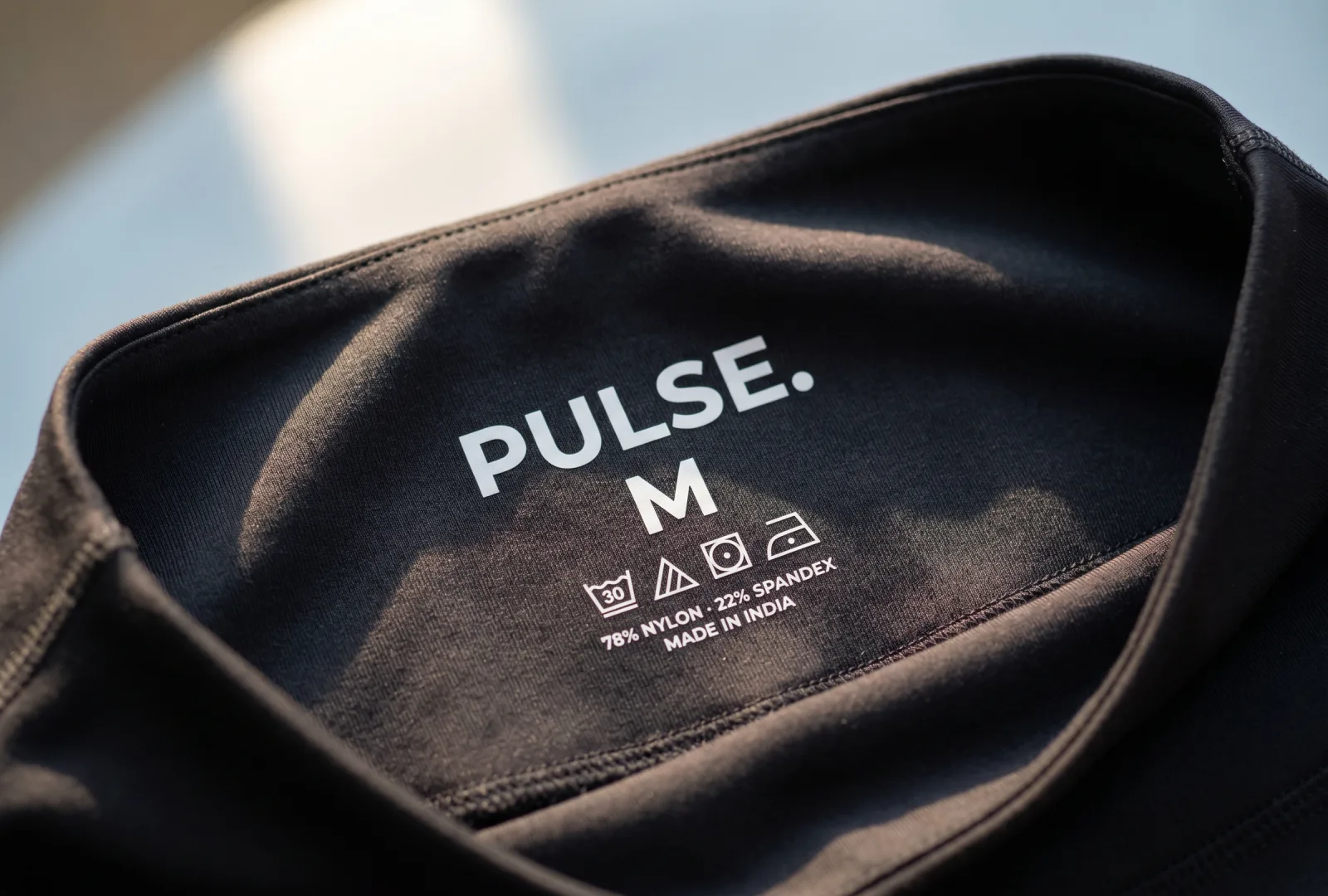
Heat-press labels aren't labels in the traditional sense. They're ink, silicone or PU directly transferred onto the inside of the garment via heat and pressure. The brand info, size and care content sit on the garment fabric itself, with nothing extra to scratch the wearer.
- Process: heat-transfer (sublimation or silicone) onto garment fabric
- Setup: requires custom plates (~₹2,500-5,000 one-time)
- Feel: zero, nothing extra, just the garment
- Best for: activewear, yoga, innerwear, athleisure, premium kidswear
- Cost: ₹0.30-4 per piece depending on volume; setup-heavy at small batches
For a deeper look at heat-press for activewear specifically, see tagless heat-press labels for activewear.
What is a woven label?
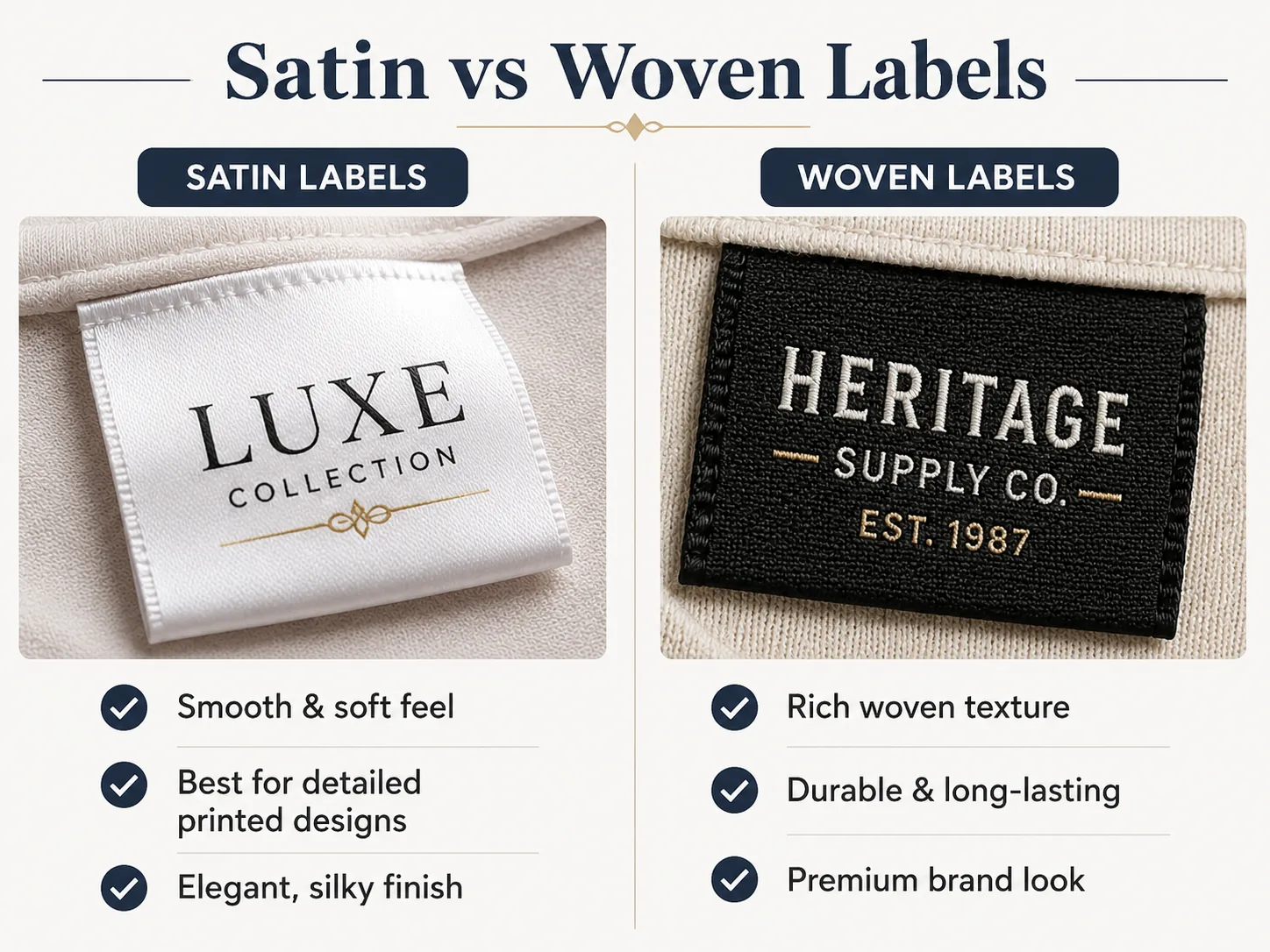
Woven labels are fabric strips with the artwork structurally woven in, then stitched into the garment (typically at the neck or side seam). Colour is permanent because it's part of the weave. Damask is the premium tier of woven.
- Process: jacquard-woven polyester thread
- Setup: no plates needed; loom configuration ~5-7 days
- Feel: fabric texture; can scratch at low-density weave
- Best for: D2C fashion, formal wear, denim, schoolwear, traditional apparel
- Cost: ₹1.10-5.50 per piece depending on volume
Head-to-head, feature comparison
- Zero feel, nothing extra against skin
- Cheapest at very high volumes (10,000+)
- Can't fall off, can't be cut out
- Works on performance fabrics with stretch
- Premium activewear standard
- Expensive at small volumes (plate setup ~₹2,500) 5,000
- Can't be removed if design changes
- Limited multi-language space. Dense care info is hard
- Plate setup adds 10-14 days to first run
- Less "premium fabric" feel
- Premium fabric feel, visible, brandable
- No setup cost, economical at any MOQ
- Easy to revise artwork between batches
- Handles multi-language wash info via book-fold
- Universal default for fashion
- Can scratch sensitive skin (low-density weave)
- Customers can cut out the label
- Adds bulk inside seams (matters for performance fabrics)
- Falls off if poorly stitched
Cost ladder, where the curves cross
Representative pricing for a 25 × 40 mm neck label position, 2026 (heat-press includes amortised plate setup):
Heat-press is actually cheaper than woven at every MOQ on a unit basis (but only because the plate setup cost (₹2,500-5,000) is amortised across the run. For batches below 200 pieces, the plate setup makes heat-press more expensive than woven; above 200, heat-press wins.
By garment type, which to pick
- Activewear, yoga, athleisure
- Innerwear, underwear, sleepwear
- Performance fabrics with stretch
- Premium kidswear (skin-friendly)
- Garments with chafing-sensitive customers
- D2C contemporary fashion
- Formal shirts & suits
- Denim & outerwear
- School uniforms & workwear
- Traditional apparel where the label is part of the brand
Decision matrix, 30-second pick
Heat-press. Zero label means zero scratching.
Woven. Plate setup makes heat-press economically unviable below this threshold.
Woven. Each artwork change on heat-press needs new plates (~₹2,500-5,000); woven is just a new loom card.
Woven. Heat-press struggles with dense multi-language info; woven can book-fold longer text.
Pro tips before you order
The smart hybrid: heat-press brand mark + woven hem flag. Tagless heat-press at the inside neck (no scratching, premium activewear feel) plus a small woven hem-flag at the side seam (visible brand presence on the rack). Combines invisibility with brand visibility.
Plate setup is amortised. Don't pay twice. Once you've paid for heat-press plates, re-runs of the same artwork are cheap. Lock the artwork before plate setup and resist design tweaks for at least 6 months.
Quick start: WhatsApp us your garment type and estimated MOQ. We'll send a heat-press sample and a woven sample of the same artwork, plus an exact per-piece cost breakdown including plate amortisation. Message Labelwala or use the quote form.
How the economics differ
The cost curves are shaped differently, and that matters more than the headline rate.
A woven label carries a loom setup: threading your colours, programming the design, running trial picks. That happens once per design regardless of run length, so woven starts expensive at low volume and improves sharply as the quantity grows.
Heat-press has a lighter setup, so it starts cheaper and improves more gently. It also removes a sewing operation from the garment line, which is a real saving your label invoice never shows. Against that, it adds a pressing operation with its own labour and its own scope for error.
The practical read: at small quantities heat-press usually wins on cost, at scale the gap narrows, and by then the decision should be made on the garment rather than the price.
Most brands should use both
Framing this as a single choice is what makes it hard, because a garment carries more than one label and the positions have different requirements.
- Neck on stretch or next-to-skin garments: heat-press. Nothing physical against the body is the entire point, and it is why premium activewear went tagless.
- Neck on woven, structured or heritage garments: woven. The tactile quality is felt when the garment is handled, and printing has no equivalent.
- Care information: printed, effectively always. Composition, symbols and origin will not weave legibly at care-label size.
- Visible external branding: woven hem tag, which reads as deliberate in a way a print does not.
The common professional arrangement in activewear is a heat-press neck print for comfort plus a woven hem tag for visible branding. That gives a neck with nothing to scratch and a garment that still reads as a brand on the shelf, which neither method delivers alone.
Test a heat-press sample properly
A heat-press label cannot be repaired, so the sampling stage carries more weight than it does on a sewn label. Five checks cover almost everything that goes wrong.
- Wash it repeatedly at the temperature your care label actually permits, and look at the edges each time. Edges lift before centres do.
- Stretch it hard across the print, fifteen or twenty times, and look for crazing in raking light. Cracking that appears in month three is visible in that test on day one.
- Rub it with a dry cloth after washing, which is roughly what a bag does to it.
- Leave a coloured sample somewhere warm for two weeks and check for dye migration. This is the only test that needs calendar time, and the one people skip.
- Feel it against skin on a body, not on a table. Stiffness that is imperceptible in the hand is obvious under a band.
Do all five on the fabric you will actually use, in the colour you will actually sell. A print approved on a black sample tells you very little about the same print on red.
Heat-press is three settings, not one process
Most heat-press failures are press failures rather than material failures, and they trace to variables that are easy to get almost right.
- Temperature. Too low and the adhesive never fully activates, so the print looks perfect and lifts at the edges after a few washes. Too high and you glaze the fabric or damage the elastane in it.
- Pressure. Drives the adhesive into the weave. Too little and it sits on the surface; too much and the platen leaves a visible shine box around the print.
- Dwell time. How long the platen stays down, and the most common shortcut on a busy line. It is invisible until the garment has been washed.
- Peel. Films are specified hot, warm or cold peel, and peeling a cold-peel film while it is still hot lifts the print off in the operator's hand.
Ask for all four in writing and keep them with the artwork. A reorder six months later is pressed by whoever is on shift that day, and a written setting is the only thing that makes the second run match the first.
A woven label has no equivalent exposure. It is made once, correctly or not, and then sewn in. That is the real reliability difference between the two, and it is about process control rather than the label itself.
How each one fails
Both survive normal washing, so the useful question is what happens when they do not.
Woven fails slowly and visibly. An edge frays, a thread pulls, the label softens. Nothing is sudden, the garment stays wearable throughout, and the label can be unpicked and replaced if it matters.
Heat-press fails suddenly and permanently. An edge lifts and then the print peels, or a rigid film crazes and splits. There is no repair: the garment now has a partly removed logo on it. On the other hand, when it is specified correctly there is nothing physical to catch or abrade in the first place.
That difference should shape how much you spend on testing rather than which you choose. Woven forgives an imperfect specification; heat-press does not.
Common mistakes
- Ordering a generic transfer for a fabric with a high elastane content.
- Approving a print on one colourway and assuming the rest of the range behaves the same.
- Skipping the two-week migration test because it needs calendar time.
- Pressing across a seam or binding, where the platen cannot apply even pressure.
- Sewing a stiff woven label into a stretch neck and expecting it to sit flat.
- Using woven for dense care text, which costs more and reads worse than print.
- Judging neck comfort by hand rather than by wearing the garment warm.
Choosing between them with Labelwala
Woven and printed labels, made by us in Ahmedabad, Gujarat, for 25 years.
- Minimum order: 1,000 pieces per design.
- Production: 7-10 days once artwork is approved. Rush jobs run 3-5 days.
- Delivery: anywhere in India; timing follows the destination and the size of the consignment.
Send the exact composition including the elastane percentage, and every colour in the range. Migration is colour-specific, so the colour list matters as much as the fabric does.
We are rated 5.0 on Google from 26 reviews.
The short answer
Heat-press for activewear, innerwear and performance garments where labels shouldn't touch skin. Woven for traditional fashion, formal wear and any brand where the label itself is a visible part of the product. Mix them on the same garment if you want zero skin contact at the neck plus visible woven brand presence at the hem.